

What Does Ship To Ship Mean?
Ship to Ship (STS) transfer – also known as lightering – is when two storage tankers moor side-by-side to transfer cargo between them.
These transfer operations usually happen in open sea or at the outer port limit off the coastline.
A STS operation can happen while both vessels are static or underway; which means to travel at low speeds.
Cargoes typically transferred during STS operations include bulk cargo of crude oil and liquefied gas.
Reasons for STS operations will be detailed in a later section.
What Happens In A STS Operation?
In order to carry out a STS transfer safely, specific procedures must be carefully followed. Here is an outline of the basic procedures carried out during STS transfer operations:
Fenders Are Lowered
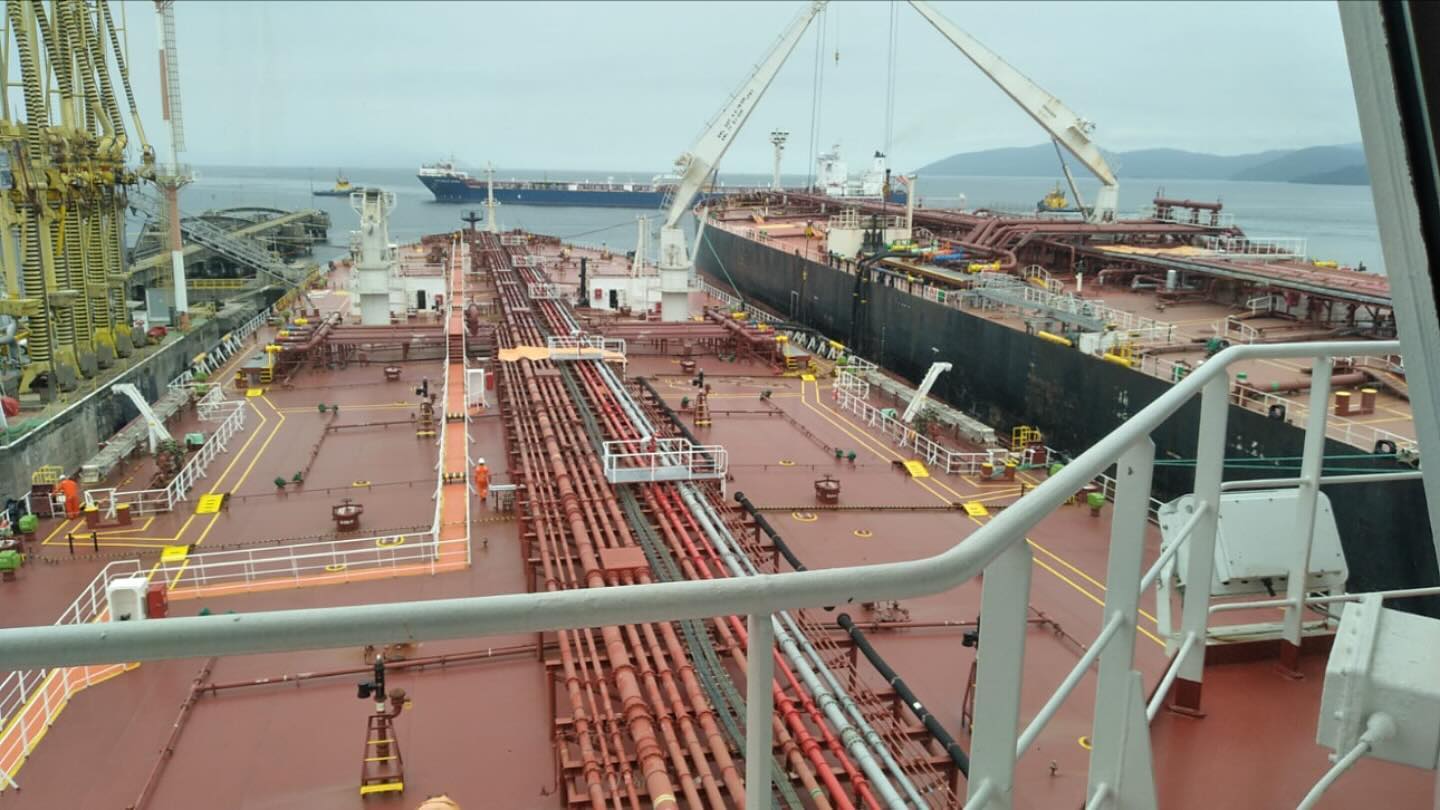
One vessel lowers its fenders – large inflatable buffers – onto the water. These are to absorb the force of the arriving vessel berthing against it.
They also ensure that no part of the two vessels collides due to the swell at sea.
Ships Approach
The second ship slows as it approaches the first, ensuring that it is correctly positioned to gently berth with the first ship.
Ships Berth
The ships berth, with the two vessels running parallel to each other. Preparations for cargo transfer can now commence.
Hoses Are Connected
Large marine hoses from the daughter vessel are raised to the deck of the mother vessel by crane. Next, these hoses are attached to the cargo transfer outlet on board the mother vessel by its crew members.
Cargo Transfer Commences
Once the hoses are attached to the outlet, cargo transfer can commence. The pumping system on board the mother vessel transfers its cargo to the daughter vessel via the hose system.
Operation Complete
Once the desired quantity of cargo has been transferred, the operation is complete. Next, the hoses are detached and returned to their vessel, one ship separates from the other and the fenders are raised.
Now, the two ships head on to their next destinations.
Additional Procedures
In addition to the main procedures required to carry out STS operations, there are also some administrative procedures that are important to note.
Overall, these are in place to mitigate risks during STS transfer operations.
Regulatory Guidelines
International bodies such as the International Maritime Organization (IMO) provide comprehensive guidelines and regulations for ensuring safety during STS operations.
All crew are required to work in accordance with the prescribed guidelines to promote safety during bulk STS transfers of petroleum products, liquefied gases and chemicals.
Updating Records
The International Convention for the Prevention of Pollution from Ships (MARPOL) lays out specific guidelines for oil cargo transfers.
All transfers between oil tankers must be recorded in the ship’s oil record book to comply with these guidelines. This is so that in the case of a polluting oil spill, MARPOL could ensure accountability.
STS Operation Plan
It is crucial that all vessels which carry out cargo transfer operations have a ship to ship transfer guide and strategy on board, known as the STS Operation Plan.
This should be written in the working language of the vessel and is meant to ensure that STS cargo operations operate smoothly.
It is imperative to regularly review vessels’ equipment and practices to ensure they meet the operational requirements set out by the operations plan.
Operation Coordinator
Between the two ships there must be one person in overall advisory control (POAC) as laid out in the operation plan. This individual is primarily responsible for the safety and success of the operation.
This could be one of the ships’ masters (captains) or a designated ship to ship Superintendent (STSSI).